
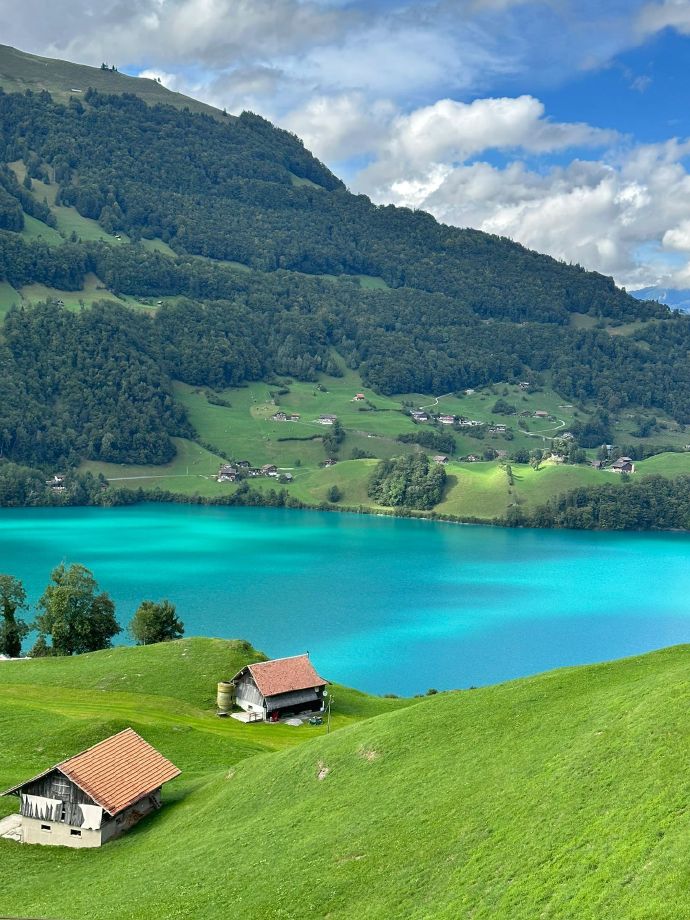
Switzerland, a beautiful country located in the heart of Europe, is known for its Alpine Mountains ⛰️ The magnificence, clarity of the lake, charm of the exquisite town, and efficient social operation attract countless travelers. I have a Swiss travel guide here, hoping to help you plan your journey preliminarily.
✨ Highlights of the Itinerary
-Classic Alpine Experience: You will have the opportunity to experience the magnificence of famous peaks in the Alps, such as Jungfraujoch and Matterhorn, up close. You can also choose to hike, ride the Glacier Express, or try paragliding to experience the beauty of nature.
-Lake and Mountain Scenery and Town Charm: During the journey, you will enjoy picturesque lake scenery such as Lake Geneva and Lake Thun, and shuttle between distinctive towns such as Zurich, Lucerne, Interlaken, and Zermatt.
-* * Cultural and Historical Exploration * *: Visit * * Ch â teau de Xiyong * *, * * Old Bern * * and other places to experience Switzerland’s profound historical and cultural heritage.
📌 Basic Information
| Project | Information |
|---|---|
| * * Best time * * | June to September (best for hiking and outdoor activities); December to March (Ski Season) |
| * * Suggested itinerary * * | 7-10 days to visit major cities and natural attractions; 16 days to embark on a deep cross-country journey |
| * * Budget reference * * | Economic type costs around CHF 100-200 per day (approximately RMB 800-1600); Comfort type will be higher |
| * * Official Languages * * | German, French, Italian, Romansh |
| * * Currency * * | Swiss Franc (CHF) |
| Visa * * | Schengen Visa |
🗓️ Switzerland itinerary plan
Switzerland has a rich variety of attractions, and it is important to plan your route in advance. You can refer to the following ideas to arrange:
flowchart TD
Trip [Switzerland itinerary planning]
Subgraph Day1 [Day 1-2: Zurich and its surroundings]
D2_1 [City Exploration: Limmat River, Old Town, Bahnhof Street]
D2_2 [Cultural Journey:<br>Zurich Art Museum (Monet, Van Gogh Works)]
end
Subgraph Day2 [Day 3-4: Lucerne and the Central Lake District]
D3_1 [Historical landmark: Capel Bridge, Dying Lion Statue]
D3_2 [Scenery of Lake District:<br>Lucerne Lake Cruise]
D3_3 [Mountain Experience:<br>Reggie Mountain or Pilatus Mountain]
end
Subgraph Day 3 [Day 5-6: Interlaken and Jungfrau Region]
D5_1 [Adventure Experience:<br>Paragliding (optional)]
D5_2 [Top of Snow Mountain:<br>Tour of Girls' Peak]
D5_3 [Lakeside Leisure:<br>Lake Thun or Lake Brienz]
end
Subgraph Day 4 [Day 7: Zermatt and Matterhorn]
D7_1 [Iconic Peak:<br>Golden Glat Observation Deck for Appreciating Matterhorn Peak]
D7_2 [Car Free Town:<br>Stroll through Zermatt Town]
end
Subgraph Day 5 [Day 8-9: Lake Geneva and Departure]
D8_1 [International City:<br>Geneva City Sightseeing (Palais des Nations, Flower Clock)]
D8_2 [Lake and Mountain Scenery:<br>Geneva Lake Cruise or Lakeside Cycling]
D8_3 [Return:<br>Departure from Geneva Airport]
end
Trip --> Day1
Trip --> Day2
Trip --> Day3
Trip --> Day4
Trip --> Day5
🚞 mode of transportation
Switzerland’s public transportation system is highly developed, efficient, and punctual, making it the preferred way to visit the country.
-Swiss Travel Pass: This pass is very cost-effective for travelers who plan to take trains, buses, and ships multiple times. It allows unlimited rides on most modes of transportation in the Swiss transportation system within its validity period, and covers scenic trains including Glacier Express and Bernina Express (although it should be noted that some scenic trains may require additional booking or seating fees), and offers free access to over 500 museums. The pass has multiple options, including 3, 4, 8, 15 consecutive days or any number of days within a month. Can be purchased according to the itinerary.
-Landscape Trains: Switzerland has several famous landscape train routes, such as the Glacier Express, Bernina Express, and GoldenPass Line, which shuttle through the Alps with magnificent scenery along the way, providing a unique way to experience Switzerland’s scenery.
-Urban transportation: Major cities such as Zurich, Geneva, Bern, etc. have dense tram and bus networks. Holding a Swiss travel pass usually allows free access to urban public transportation in these cities.
💰 Travel budget
The travel cost in Switzerland is relatively high, so it is important to plan your budget in advance. The following table lists the estimated main expenses (calculated in RMB, for reference only, actual expenses vary from person to person):
| Expense category | Economy type (about/person) | Comfort type (about/person) | Remarks |
|---|---|---|---|
| * * Round trip airfare * * | 5000-8000 | 8000-16000+ | Prices vary by season, airline, advance booking time, and whether there is a connecting flight |
| * * Accommodation (per night) * * | 400-1200 | 1600-3000+ | Youth hostel beds to economy hotels/mid to high end hotels, prices fluctuate greatly depending on the city and season |
| * * Catering (daily) * * | 300-600 | 600-1500+ | Supermarket light meals, self-service cooking/restaurant dining |
| * * Transportation (domestic) * * | 2000-4500 | 4500+ | Depending on whether you use the Swiss Travel Pass and the itinerary range |
| * * Scenic spot tickets and activities * * | 1500-2000+ | Variable | Tourist attractions such as Girls’ Peak have higher fees, many natural landscapes are free, and museums can use passes |
| * * Total (7 days) * * | * Approximately 12300-22000+* * | * * Variable, usually higher * * | The above is a rough estimate, and additional expenses such as shopping and emergency are not included. It is recommended to plan according to one’s own itinerary and consumption habits, and reserve flexible funds. |
| **Budget saving tips * *: | |||
| -Accommodation: Consider booking a homestay or apartment, especially when traveling with multiple people, which may be more economical. | |||
| -* * Catering * *: Use supermarkets (Coop, Migros) to purchase ingredients, cooked food or salads, and make homemade light meals. | |||
| -* * Attractions * *: Many landmarks (such as Bern Old Town and Lucerne Cabell Bridge) can be visited for free. Make good use of the free museum admission benefits included in the Swiss travel pass. | |||
| -* * Transportation * *: Plan your itinerary in advance and compare point-to-point ticket and general ticket prices. Swiss travel passes are usually more cost-effective for long-distance travel and multi destination tours. |
🏔️ Main attractions and recommended activities
Switzerland’s attractions are spread throughout the country, and here are some classic choices:
| Name of attraction/activity | Region | Highlights and experiences | Approximate cost (reference) | Remarks |
|---|---|---|---|---|
| * * Jungfrau * * | Interlaken region | Europe’s top, take the gear train to the summit, enjoy the snow capped mountains, glaciers, and Aletsch Glacier | Cable car round-trip cost about 1400 RMB | Weather has a great impact on the tourist experience, be sure to check in advance |
| * * Matterhorn * * | Zermartre Region | Switzerland’s iconic mountain peak, which can be enjoyed on foot or by taking the G ö rngralt train | Zermartre is a car free town with a peaceful environment | |
| * * Lake Geneva * * | Geneva/Montreux and other places | Beautiful lake scenery, can be visited by boat, visit the Ch â teau de la Cit é and the La Vineyard Terraces (World Cultural Heritage) | Ch â teau de la Cit é ticket takes about 20 minutes to visit | |
| Lake Lucerne and the Old Town | Lucerne | Capel Bridge, Dying Lion Statue, Strolling through the Old Town | ||
| Glacier Express * * | St. Moritz Zermatt | “The slowest sightseeing express in the world”, enjoying the beautiful scenery of the Alps along the way | Seat reservation is required in advance | |
| * * Golden Mountain Pass Express * * | Montreux Interlaken Lucerne | Another famous panoramic train route that crosses lakes and mountains | ||
| Hiking * * | Many parts of the country | Switzerland is a hiking paradise, such as watching the Aletsch Glacier in Fiesch, hiking by Lake St. Moritz, etc., with a large number of different difficulty routes to choose from | Many trails are free | Suitable equipment needs to be prepared |
| * * Skiing * * | Multiple Alpine ski resorts | Main winter activity with world-class ski resorts and equipment | Varies by ski resort and season | Winter limited edition |
🍫 Culinary experience
Swiss cuisine is also worth exploring:
-Fondue: A traditional Swiss dish where bread is dipped in melted cheese.
-* * Grilled Sausage (Cervelat/Brathurst) * *: A common street snack or restaurant delicacy.
-R ö sti: Fried potato cakes, often served as a staple food.
-Swiss Chocolate: Renowned for its quality worldwide, why not visit a chocolate factory or purchase and taste it directly at supermarkets or specialty stores.
-Swiss wines, especially those produced in areas such as the terraced fields of the Lavo vineyard, are worth tasting.
⚠️ Practical Information and Suggestions
-* * Language * : Switzerland has four official languages: German, French, Italian, and Romansh. The English penetration rate in major tourist areas is relatively high, but learning a few greetings in the local language always brings convenience. -Currency and Payment: Switzerland uses the Swiss Franc (CHF). Credit cards (Visa, MasterCard) are widely used, but in some small towns, markets, or when purchasing small items, a small amount of cash is still required. – * Power socket * : C-type (two hole round plug) or J-type (three hole round plug), voltage 230V, conversion plug needs to be prepared. – * Travel Insurance * : It is strongly recommended to purchase travel insurance that covers medical expenses, lost luggage, and itinerary cancellations. -Safety: Switzerland is generally very safe, but personal belongings still need to be taken care of, especially at popular attractions and on transportation. – * Booking * *: Travel during peak seasons (summer, skiing season, and public holidays), * * be sure to book * * accommodation, seats on popular landscape trains (such as Glacier Express), and certain activities (such as Jungfrau train tickets) in advance to avoid disappointment.
-Weather and Equipment: The weather in mountainous areas is unpredictable, with large temperature differences between morning and evening even in summer, and it may rain at any time. Be sure to wear it in layers and prepare a waterproof jacket and comfortable hiking shoes. Sunscreen and sunglasses are also important.
-* * Closed on Sundays * *: It should be noted that most shops in Switzerland are closed on statutory holidays and Sundays, but attractions, restaurants, and hotels are not affected. Please plan your shopping in advance.
-Communication: Switzerland is not part of the European Union, and most EU SIM cards cannot be used in Switzerland or incur high roaming fees. Consider purchasing a local prepaid SIM card or using the hotel’s Wi Fi.
💎 summary
Switzerland is a country worth slowing down and immersing oneself in its natural beauty and cultural heritage. Whether it’s taking a train through a valley, leisurely strolling in a lakeside town, or taking on a mountain hike challenge, you can all gain unforgettable experiences.
I hope the above information can help you plan your trip to Switzerland preliminarily. **The surprise of a journey often lies in those unexpected moments, so don’t forget to leave some time for yourself to explore and discover freely. Wishing you a perfect trip to Switzerland!
